


 By
- Aaliya Yousaf.
 Blog
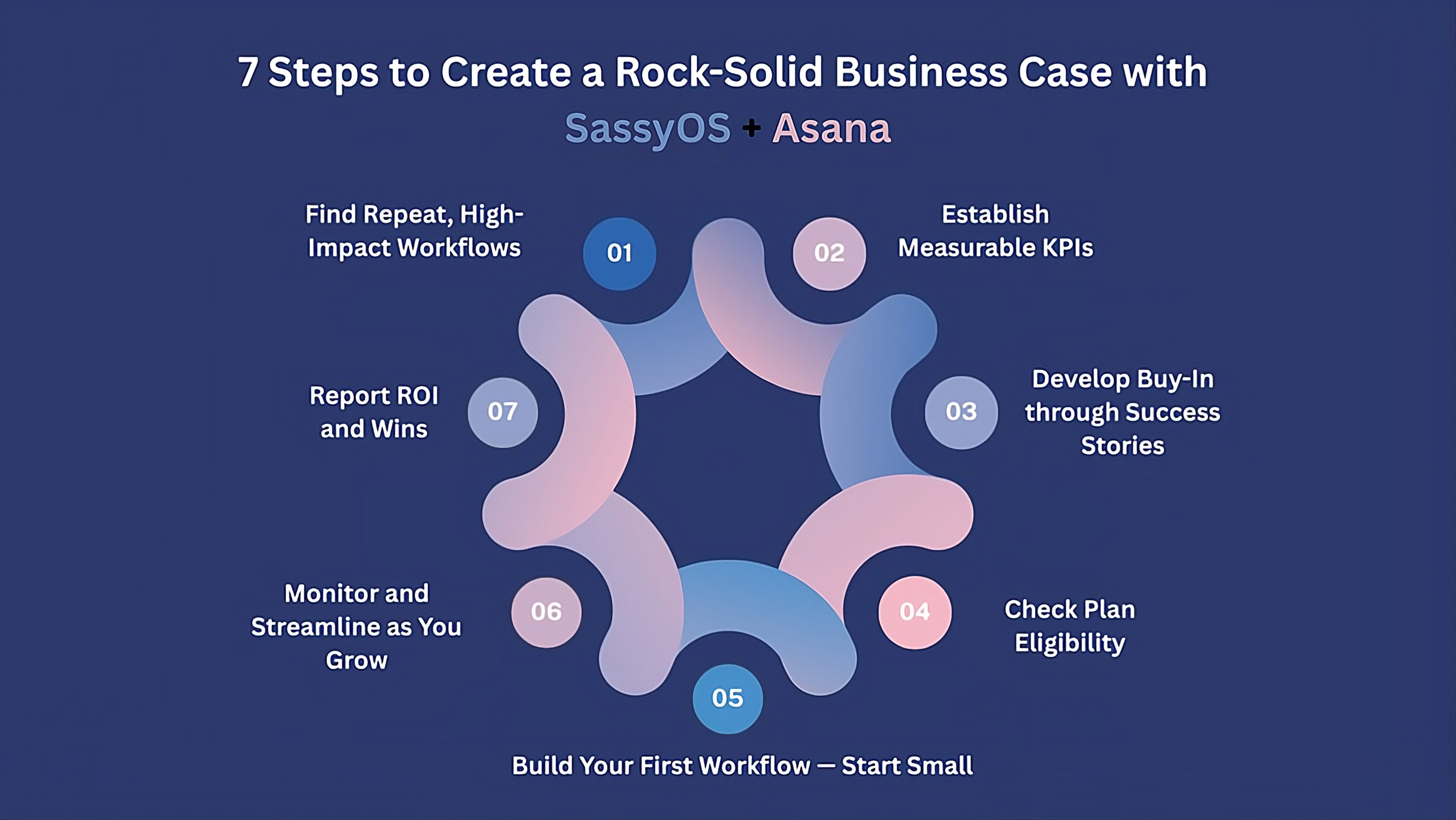
In today's hyper-connected world, creating a rock-solid business case is not an option — it's a necessity. Those companies who think ahead, bring multi-perspective teams together, and leverage technology company like SassyOS a trusted Asana Partners in Dubai and the Middle East are leading the charge.
This article takes you through seven best practices to develop a business case that delivers credible ROI, gains buy-in from stakeholders, and hastens your workflow automation and task and project management software adoption.
A great business case alerts decision-makers to the worth of a project, identifies risks, maximizes use of resources, and attains organizational objectives earlier. SassyOS work as a Asana Partner in UAE help organizations manage build projects, monitor KPIs, and automate workflows under one roof.
The foundation of a well-built business case is beginning with the finding of repeat and high-impact processes. These are processes that consume most resources and time. Working on them initially brings in the highest ROI on your time.
Hack: Use project management tools like Asana to analyze bottlenecks and targets to automate.
There must be measurable easy-to-measure KPIs so that the success can be measured. Develop such measures as project delivery ratios, time saved, cost saved, or enhanced teamwork measures.
ROI-producing teams earlier in the cycle allows it to become easier to be able to prove later ROI.
You are more likely to succeed with stakeholder finance if they can view evidence of success. Utilize recent case studies, customer feedback or pilot scheme results to provide evidence of value to your bid.
Asana tools enable you to generate reports and dashboards so that it is easy to report on influence.
Not all plans are created equal. Check your Asana plan eligibility — Advanced, Enterprise, or Enterprise+ — to ensure you’re using the right features for your business size and goals.
Enterprise plans often include premium integrations, advanced security, and enhanced reporting capabilities — all essential for scaling workflows.
A successful business case begins with a pilot flow to start, sufficiently large enough to manage. It will provide you with the capability to pilot your method, measure the effect, and work out your system prior to implementing it to the entire organization.
Begin incrementally by piloting one or two processes with quality deliverables and measurable outcomes.
No process will be flawless day one. Walk through and audit workflows periodically, examine and check performance statistics, and even roll up processes with organizational expansion.
Asana provide analytics and live reporting to monitor progress and where to improve.
Lastly, report ROI and victories back to stakeholders. Provide success metrics, month-end reports, and dashboards to maintain support.
When management witnesses actual results — lowered cost, enhanced productivity, or faster project delivery — they will most probably reward subsequent projects.
With integration of Asana, companies learn:
The integration clocks your business with data-driven decision-making or growth-driven fuel.
A sound business case is the foundation of any thriving project. With these seven steps, your team will be automated or streamlined out of tedious tasks, improved or enhanced performance, and produced tangible results.
