


 By
- Aaliya Yousaf.
 Blog
A claim moves through a sequence of steps with a clock running the entire time — intake, document collection, assessment, approval, payout — and most insurance businesses operate under service-level commitments that make delays a real, measurable cost. Your policy administration system tracks the claim record and payment status well. What it doesn't always track cleanly is which internal task is holding a claim up right now, and whether that claim is approaching an SLA breach before it's already too late to intervene.
Policy details, claim records, and payout data belong in your policy administration or claims management system, which is built specifically for that and typically already handles it well. Asana's role is coordinating the process around a claim — which document is outstanding, whether assessment is running behind, whether an SLA deadline is approaching — referenced by claim number rather than duplicating the underlying claim data.
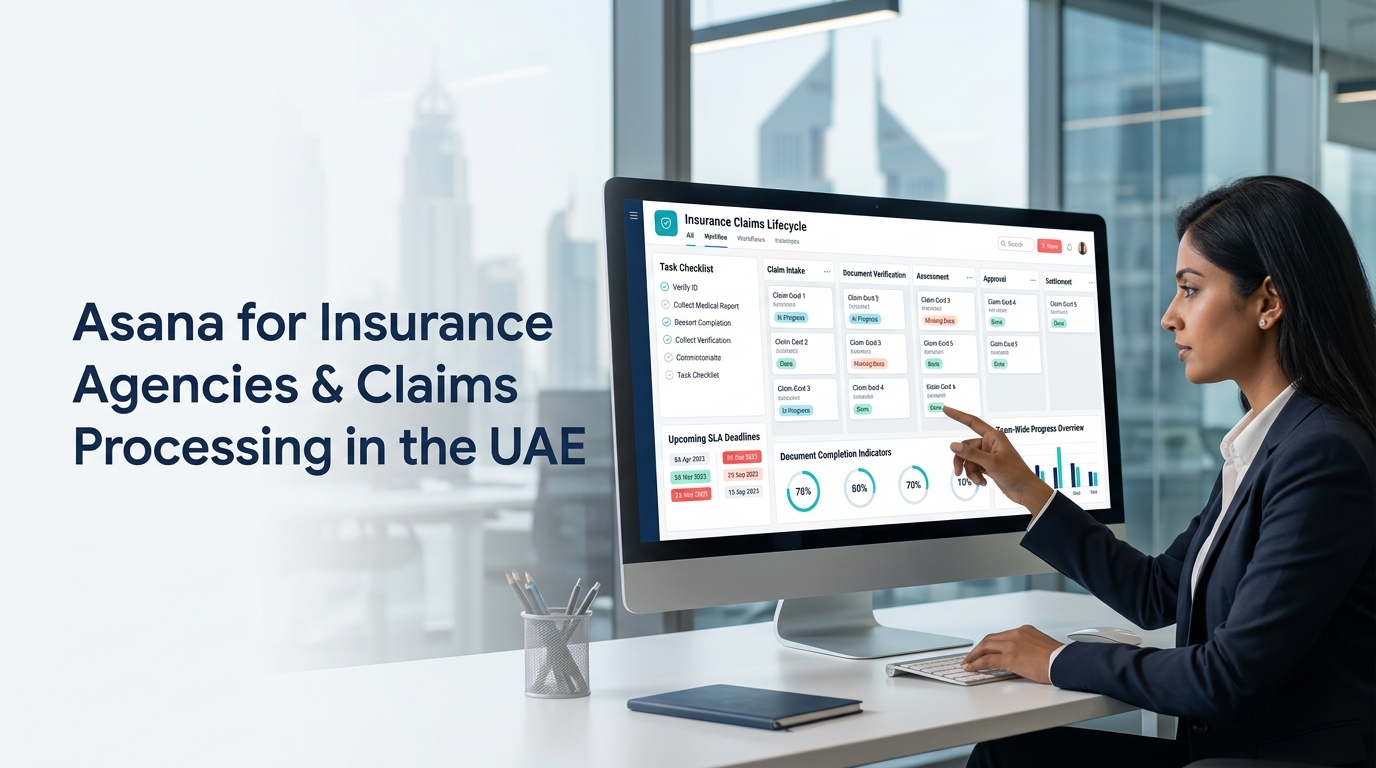
Most claims follow a broadly consistent sequence — intake, document verification, assessment, approval, settlement — which makes a project template covering that sequence genuinely useful. Duplicated for every new claim, with clear ownership at each stage, it removes the "what's actually outstanding on this file" uncertainty that otherwise requires opening the full claim record to answer.
An SLA deadline that's only discovered as breached, rather than flagged as approaching, has already cost the business its commitment. A due date on each claim's checklist, set against the actual SLA target with a buffer built in for internal review time, surfaces risk while there's still time to act — following the same principle covered in more depth in our Timeline and Gantt chart guide, applied to claims processing specifically.
Claims frequently stall on a single missing document — a police report, a medical certificate, proof of ownership — and knowing exactly what's outstanding at a glance is what actually keeps a claim moving. A checklist task per claim, with each required document marked complete only once genuinely received, removes the ambiguity of assuming something's been submitted when it's still pending. For claimant-submitted documents specifically, a structured intake form, covered in more depth in our Asana Forms guide, standardizes submission and automatically creates the tracking task.
Policy renewals due on a set schedule are exactly the kind of predictable, recurring work that benefits from automatic reminders rather than depending on someone remembering. Recurring tasks tied to each renewal date, with generous advance notice, turn a renewal calendar that might otherwise live in a spreadsheet into a tracked system that surfaces upcoming renewals before they're missed.
Claims managers typically want to know, across every open claim on the team, which are progressing normally and which are approaching or past an SLA target. A portfolio rolling up every active claim's stage and deadline status gives that visibility directly, echoing the reporting principle covered in our Goals and Portfolios guide, without needing to individually check in with every claims handler.
As with any operation handling personal and financial information, it's worth being deliberate here: policyholder personal details, medical information, and payout amounts belong in your policy administration or claims system, not written directly into Asana tasks. Asana should reference a claim or policy number for operational coordination, rather than storing the policyholder's personal or financial data itself.
Insurance claims processing involves a specific mix of SLA pressure, document-heavy workflows, and recurring renewal cycles that a generic project template doesn't account for. This is what we build into every insurance-focused implementation.
We build stage-based checklists with deadlines set against your actual service commitments.
Forms standardize document submission and automatically generate tracking tasks.
We build portfolio visibility so managers spot at-risk claims before they breach, across the whole team.
Claims processing runs against a clock, and most delays come down to the same causes — a missing document nobody chased, an SLA deadline nobody flagged in time, a renewal nobody remembered. Structured around a stage-based checklist, SLA-aware deadlines, and team-wide visibility, Asana closes that coordination gap without duplicating what your claims system already tracks.
If claims on your team still stall on missing paperwork, book a free consultation with SassyOS and we'll show you what a properly structured setup looks like.
Core Asana Services
Feature Guides
Related Industries
Reporting
We'll build your Asana workspace around stage-based checklists, SLA-aware deadlines, and team-wide claims visibility.
Book a Free Consultation Get in Touch