


 By
- Aaliya Yousaf.
 Blog
A property sale in the UAE moves through a distinct sequence — listing, viewings, offer negotiation, documentation, and a closing process involving multiple external parties like banks, developers, and legal representatives. Your CRM tracks the listing and the lead well. What it doesn't always capture cleanly is the task-level coordination behind a deal actually closing — which document is still outstanding, which viewing needs scheduling, which approval is the one thing standing between an offer and a signed contract.
Listings, buyer and seller contact details, and lead data belong in your CRM or listing portal, which already does that well. Asana's value here is coordinating the task-level work behind each active deal — the checklist of what still needs to happen before closing, and who's responsible for each piece — not managing the listing itself.
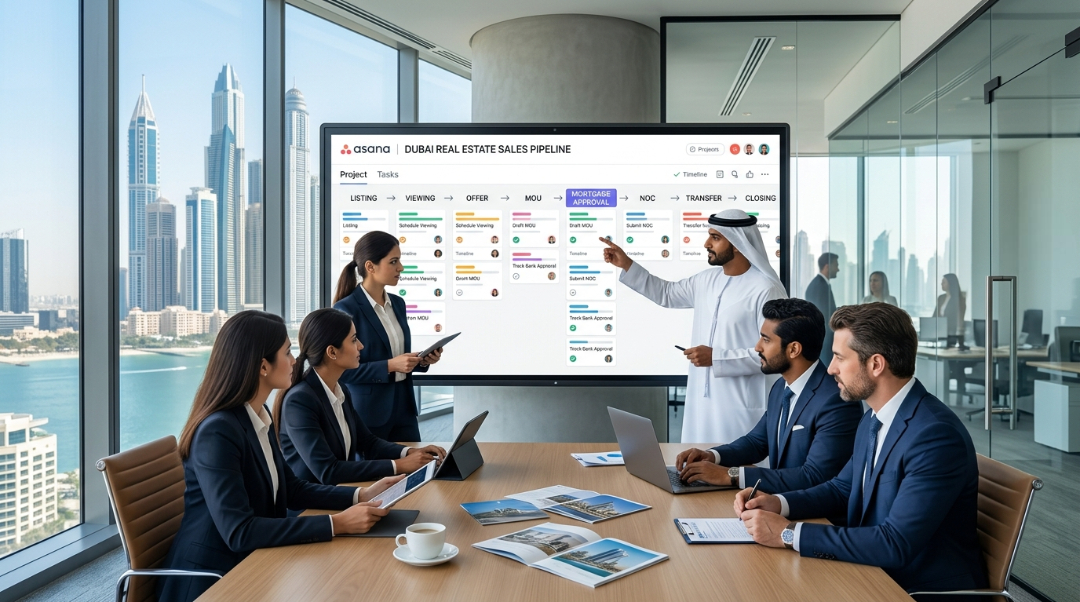
Once an offer is accepted, a fairly consistent sequence follows — MOU signing, deposit, mortgage approval where applicable, No Objection Certificate, transfer appointment. A project template covering this sequence, duplicated for every deal that reaches this stage, keeps the closing process visible and trackable rather than relying on the agent's memory of what's outstanding for each of their active deals.
A viewing that doesn't get followed up promptly is a lead quietly going cold. A task created for each scheduled viewing, with a follow-up reminder set immediately after, ensures interested buyers hear back while their interest is still fresh, rather than following up days later once momentum has faded.
Closing a deal often depends on external parties who aren't part of your team — a bank processing a mortgage, a developer confirming NOC issuance, a legal representative handling documentation. A structured intake form, covered in more depth in our Asana Forms guide, lets these parties confirm status or flag a delay without needing platform access, with submissions landing as tasks tied to the specific deal.
Brokerage leadership typically wants to know how many deals are active across the whole team, which are close to closing, and which are stuck on an external dependency. A portfolio rolling up every agent's active deals gives that visibility directly, echoing the reporting principle covered in our Goals and Portfolios guide, without requiring a manual pipeline review meeting with every agent individually.
Off-plan sales carry a different rhythm — payment plans tied to construction milestones, handover timelines set by the developer, and buyer communication that needs to happen at each stage. Milestone tasks tied to each payment or construction stage, similar to the payment-linked milestone approach covered in our construction and real estate guide, keep this longer-running sales relationship organized across months or years rather than relying on a developer's own updates as the only source of tracking.
As with any customer-facing business, it's worth being deliberate here: buyer and seller personal details, financial information, and passport or Emirates ID data belong in your CRM or a secure document system, not written directly into Asana tasks. Asana should reference a deal by reference number for operational coordination, rather than storing the client's personal or financial data itself.
Real estate sales coordination involves a specific mix of external-party dependencies and long sales cycles that a generic project template doesn't account for. This is what we build into every brokerage-focused implementation.
We build repeatable checklists covering your firm's actual closing process, from MOU through transfer.
Forms let banks, developers, and legal representatives confirm status without needing platform access.
We build portfolio-level visibility across every agent's active deals for brokerage leadership.
Your CRM manages the listing and the lead. What determines whether a deal actually closes on time is the coordination behind it — the checklist, the external approvals, the follow-up that doesn't slip. Structured around a closing checklist and clear external-party coordination, Asana handles that layer without duplicating what your CRM already does.
If deals at your brokerage still depend on individual agents keeping track in their heads, book a free consultation with SassyOS and we'll show you what a properly structured setup looks like.
Core Asana Services
Related Industries
Feature Guides & Reporting
We'll build your Asana workspace around closing checklists, external-party coordination, and team-wide pipeline visibility.
Book a Free Consultation Get in Touch