


 By
- Aaliya Yousaf.
 Blog
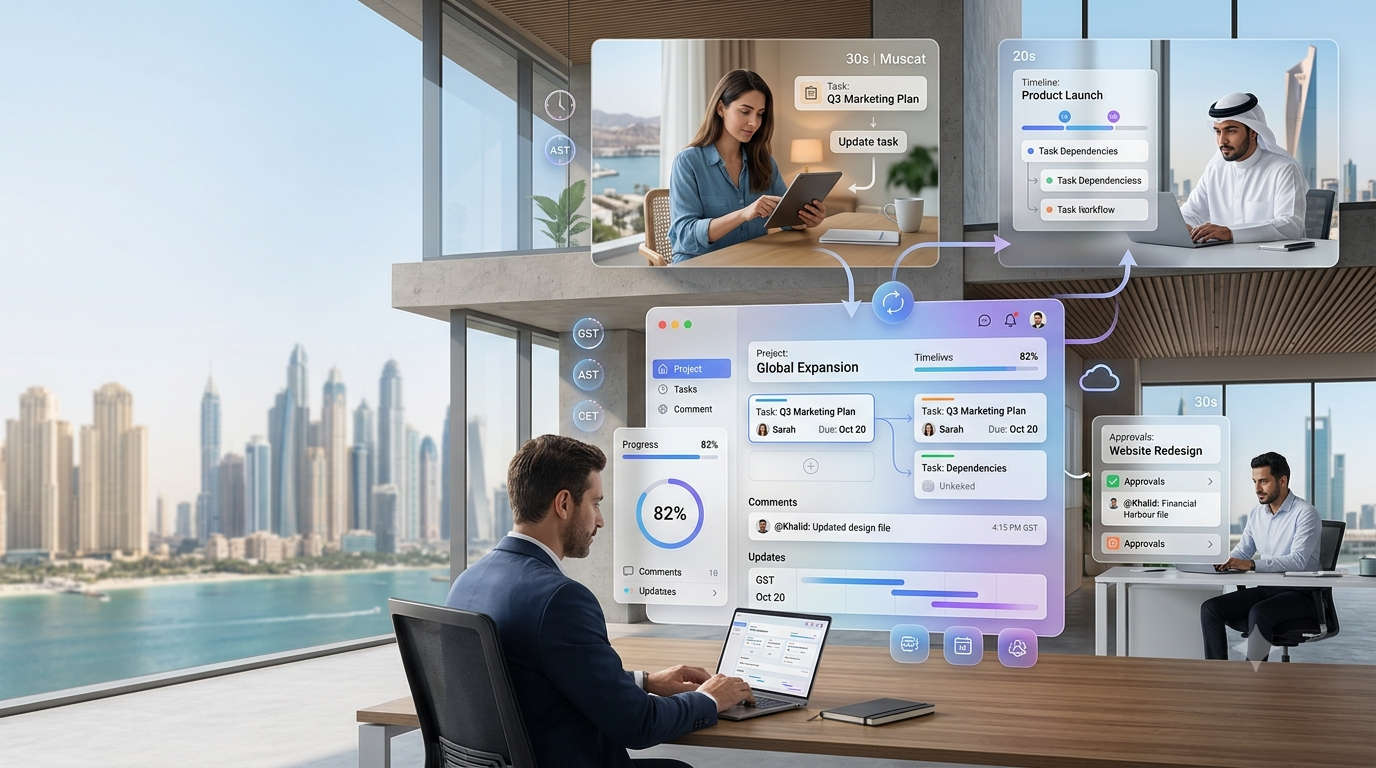
Hybrid work didn't go away after the initial shift to remote — it just became the default, and coordination problems that used to get papered over by everyone being in the same office became permanent. A UAE business with staff split between Dubai, a satellite office in another emirate, and a few people working fully remote from elsewhere in the GCC doesn't need more meetings to stay aligned. It needs a system where status doesn't depend on someone being online at the same time as everyone else.
A hybrid or remote team doesn't struggle because people are in different places. It struggles when work depends on everyone being available at the same moment — a status update that only happens in a meeting, an approval that only happens over a call, a handoff that only happens if you happen to catch someone on WhatsApp. Asana's real value for distributed teams is removing that synchronous dependency, so work keeps moving even when nobody's online at the same time.
Async-first doesn't mean no meetings — it means the default assumption is that work can progress without one. That shift changes how tasks, comments, and updates get structured from the ground up.
The teams that adapt fastest are the ones that write more detail into the task itself upfront — which feels slower on the first pass, but removes the back-and-forth that async work otherwise multiplies.
For UAE businesses with team members across the GCC, or with remote hires further afield, due dates and deadlines need to be unambiguous by design, not by convention.
A lot of remote-work friction comes down to one habit: checking whether someone's active before assuming any progress has happened. My Tasks and project-level status views remove the need for that check entirely — anyone can see what's moved, what's stuck, and what's overdue without pinging a colleague to ask "hey, quick question."
This works best when task status is kept current as part of doing the work, not as a separate end-of-day update — which is exactly the habit that a properly structured rollout needs to build in from the start, not bolt on later.
Distributed teams tend to overcorrect in one of two directions — too many meetings to compensate for lost in-person visibility, or too few, leaving real misalignment to fester. A useful middle ground: reserve meetings specifically for decisions and discussion, and use Asana's status views and comments for anything that's purely informational. If a meeting's only purpose is reporting what already happened, that's a sign the reporting layer isn't doing its job — a theme we cover in more depth in our Goals and Portfolios guide.
New hires in an office pick up a lot informally — overhearing context, tapping a neighbor on the shoulder for a quick question. Remote hires don't get that by default, which means onboarding structure has to work harder to compensate.
A detailed onboarding project — the kind we cover in our HR and recruitment guide — matters even more for remote hires specifically, since the checklist itself often has to substitute for the informal knowledge transfer an in-office hire would pick up naturally in their first few weeks.
The fix in every case is the same: whatever happens informally for in-office staff needs an equivalent written, task-based process — or the distributed part of the team quietly falls behind.
Distributed and hybrid teams need a rollout designed around asynchronous work from the start — not a standard implementation with "remote-friendly" bolted on afterward.
We build workflows that don't depend on real-time availability, so work keeps moving across time zones.
Every session is available in Arabic and English, so language isn't an added barrier on top of physical distance.
Support that's aligned to your team's working hours, whether they're in Dubai, Muscat, Kuwait City, or Manama.
Hybrid and remote teams don't need more tools to feel closer together — they need work structured so it doesn't depend on everyone being online at once. Asana handles that well when task detail, status visibility, and dependencies are built deliberately, rather than treating distributed work as a smaller version of an in-office setup.
If your distributed team is still relying on meetings to stay aligned, book a free consultation with SassyOS and we'll show you what an async-first setup looks like.
Core Asana Services
Rollout & Reporting
Industry & Team Use Cases
Partner Coverage & Pricing
We'll build an async-first Asana workspace for your distributed team, wherever they're logging in from across the GCC.
Book a Free Consultation Get in Touch