


 By
- Aaliya Yousaf.
 Blog
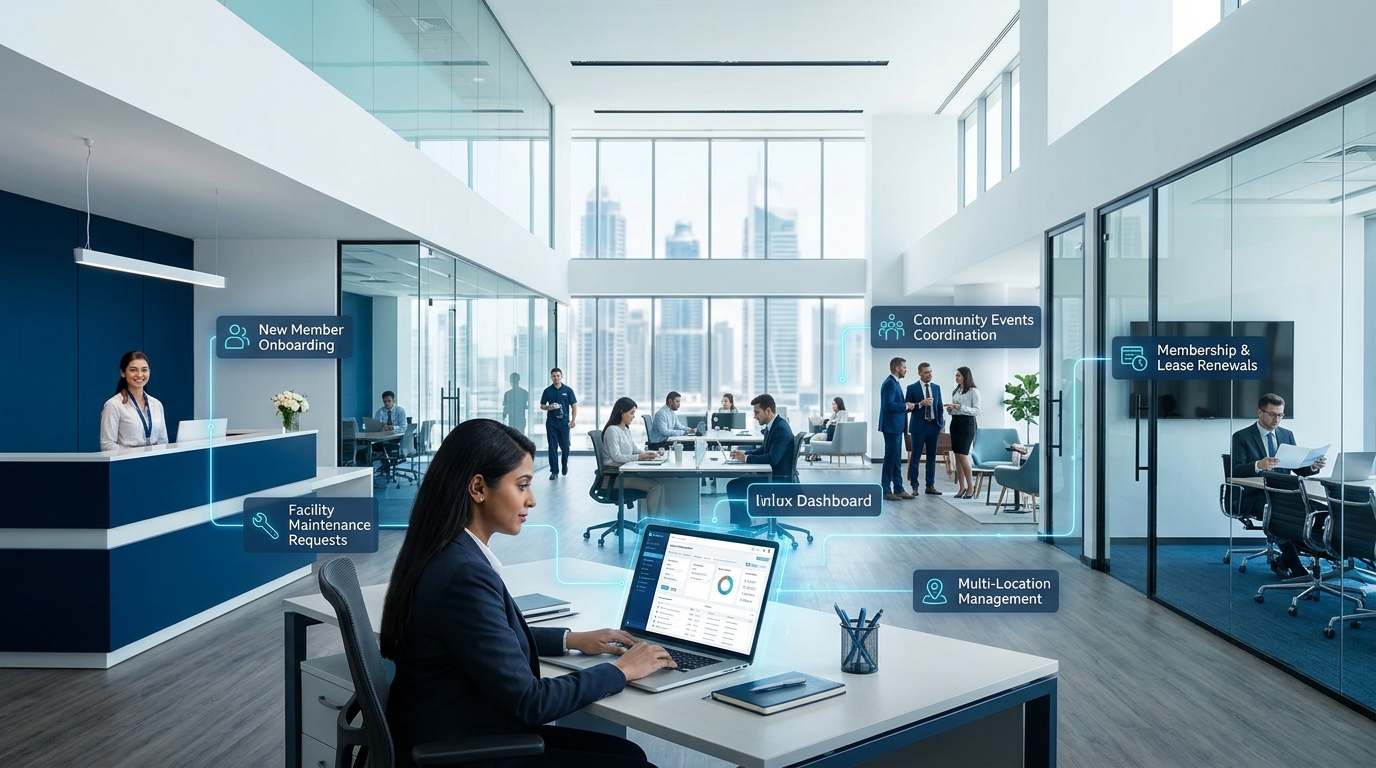
A co-working space or business center runs on membership software that handles bookings, billing, and access control well. What it doesn't handle is everything happening around that — a new member's onboarding, a meeting room maintenance issue, a member complaint that needs following up, a community event that needs coordinating across the team, or a lease renewal approaching for a member on a longer-term desk. With the UAE's flexible workspace market growing quickly, that operational layer behind the membership is exactly where most centers are still improvising.
Desk bookings, meeting room reservations, and membership billing belong in your workspace management platform, which already handles that well. Asana's role is the operational layer around the member experience — onboarding, facility issues, community coordination, and renewal follow-up — referencing a member by account number where needed, rather than duplicating booking data.
A new member joining involves access card setup, a facility walkthrough, an introduction to the community, and often a welcome package — a sequence that benefits from being a repeatable template rather than reconstructed informally by whoever happens to be at the front desk that day. This keeps the first impression consistent regardless of which staff member handles a given onboarding.
A broken air conditioning unit, a printer down, a meeting room AV issue — these need to reach facilities or maintenance quickly, and depending entirely on a verbal handoff to the front desk creates a single point of failure. A structured intake form, covered in more depth in our Asana Forms guide, lets any staff member or even members themselves log an issue directly, with automation routing it to the right team and flagging urgency based on the category selected.
Networking events, workshops, and member community activities need space booking, catering, invitations, and setup all coordinated ahead of a fixed date — the same countdown pattern covered in more depth in our events management guide. Treating each event as its own countdown project keeps community programming consistent rather than being pulled together last-minute each time.
Longer-term members on dedicated desks or private offices typically have renewal dates that carry real revenue implications if missed. Recurring tasks tied to each renewal date, with generous advance reminders, turn a renewal calendar that might otherwise live in a spreadsheet into a tracked system that surfaces upcoming conversations before they become last-minute scrambles.
Operators running several co-working locations benefit from the same portfolio structure used across other multi-branch businesses: one project per location for local operational tasks, rolled up into a shared portfolio giving management a single view of facility issues, upcoming renewals, and event schedules across every location without visiting each one individually.
As with any membership-based operation, it's worth being deliberate here: member personal details, company information, and payment data belong in your workspace management platform, not written directly into Asana tasks. Asana should reference a member by account number for operational coordination, rather than storing personal or company data itself.
Co-working and business center operations involve a specific mix of member experience, facility upkeep, and recurring renewal cycles that a generic project template doesn't account for. This is what we build into every workspace-operator implementation.
We build a repeatable onboarding checklist so every new member gets a consistent first experience.
Forms let staff and members flag facility issues quickly, without a front desk bottleneck.
Portfolio visibility gives management a live view of every location's operational status.
Membership software runs the booking and billing side of a co-working space well. What determines whether the member experience actually feels premium is the layer behind it — consistent onboarding, fast facility response, coordinated community events, and renewals that don't sneak up. Structured properly, Asana closes that gap without duplicating what your workspace platform already handles.
If onboarding and facility issues at your space still depend on whoever's at the desk that day, book a free consultation with SassyOS and we'll show you what a properly structured setup looks like.
Core Asana Services
Feature Guides
Related Industries
We'll build your Asana workspace around consistent onboarding, fast facility response, and renewal tracking — for every location you run.
Book a Free Consultation Get in Touch