


 By
- Aaliya Yousaf.
 Blog
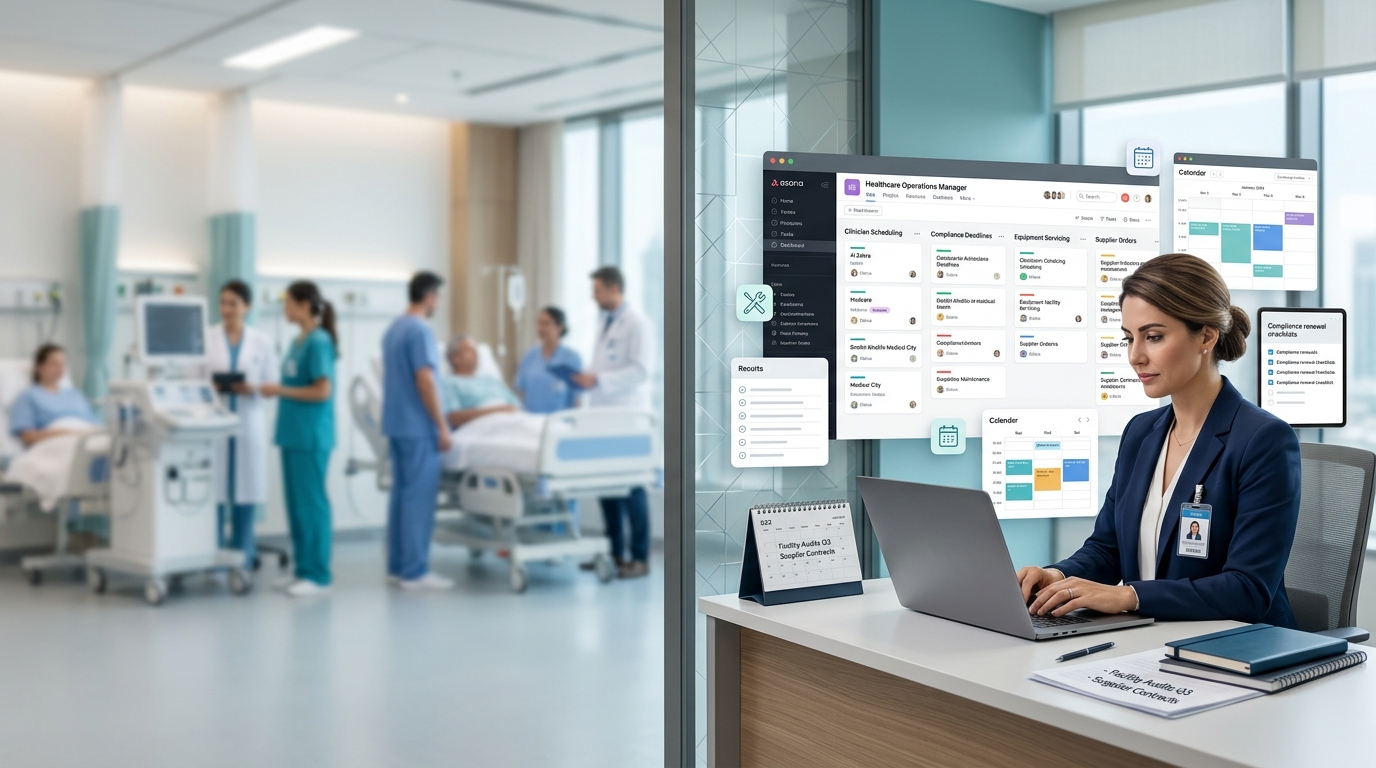
Clinics and healthcare operations in the UAE run on two parallel tracks: clinical work, which lives in specialized systems built for medical records and patient care, and operational work — staff scheduling, supplier orders, compliance renewals, facility maintenance — which often doesn't have a proper home at all. That operational layer is where Asana fits, and it's important to be precise about the boundary: Asana coordinates the operational work around healthcare delivery, and has no place storing anything clinical.
This is worth stating plainly before anything else: patient records, diagnoses, treatment notes, and any clinical information belong exclusively in your licensed clinical systems, governed by the regulatory and privacy requirements that apply to healthcare data. Asana's role here is strictly the operational layer around delivering care — not the care itself. Every recommendation in this guide respects that boundary.
The pattern across every "fits in Asana" row is the same: operational coordination without a patient's name attached. That distinction is what keeps the setup both useful and appropriately scoped.
Clinics running multiple shifts, on-call rotations, or cross-department staff coverage face a coordination challenge that's entirely operational — who's covering which shift, who's on call, whether a department is short-staffed on a given day. A shared project tracking shift assignments and coverage gaps gives administrators a clear view without needing to reference any patient-facing system, and swap requests can flow through a structured intake form rather than informal text messages that are easy to lose track of.
Healthcare facilities in the UAE carry a heavier compliance load than most sectors — facility licenses, individual practitioner certifications, equipment calibration schedules, and health authority inspections all operate on renewal cycles with real consequences for lapses. Recurring tasks tied to each renewal date, with generous advance reminders, turn a compliance calendar that currently lives in someone's memory or a spreadsheet into a tracked system with clear ownership for each renewal.
Medical supply ordering and equipment maintenance are entirely operational, with no clinical data involved, making this one of the most straightforward fits. A supplier intake form standardizes order requests across departments, while recurring maintenance tasks for equipment servicing — with completion checklists attached — reduce the risk of a compliance issue or equipment failure being discovered at the worst possible moment.
For healthcare groups operating multiple clinic locations, the same site-based portfolio structure used across other industries applies well here: one project per location for local operational tasks — staffing, supplies, maintenance, compliance — rolled up into a shared portfolio for group-level administrative visibility. This gives leadership a single view of operational health across every location without any clinical data ever entering the picture.
The easiest way this boundary gets crossed isn't a deliberate decision — it's convenience creep. A task description that starts referencing "the patient in room 3" instead of a case number, or a comment thread that drifts into clinical detail because it was faster than switching systems. The practical fix is training the team explicitly on where the line sits, and defaulting to case or reference numbers instead of patient names in any Asana task, even for purely administrative coordination tied to a specific patient visit.
Healthcare operational coordination needs a setup that respects the clinical/operational boundary from the very first project created, not as an afterthought once something's already been logged incorrectly.
We help define clearly what belongs in Asana and what stays in clinical systems, before the workspace goes live.
Renewal deadlines and recurring checks are structured with the reminders and ownership your compliance load actually needs.
Onboarding explicitly covers what belongs in the workspace, reducing the risk of convenience-driven scope creep later.
Healthcare operations carry real coordination overhead that has nothing to do with clinical care — staffing, compliance, supplies, facilities — and that layer deserves proper structure just as much as any other business. Asana handles it well, as long as the boundary with clinical systems is respected deliberately, not assumed to hold on its own.
If your clinic's operational coordination is still scattered across spreadsheets and group chats, book a free consultation with SassyOS and we'll show you what a properly scoped setup looks like.
Core Asana Services
Security & Sensitive Data
Feature Guides
We'll build your operational Asana workspace with clear boundaries respected from day one — no clinical data anywhere near it.
Book a Free Consultation Get in Touch