


 By
- Aaliya Yousaf.
 Blog
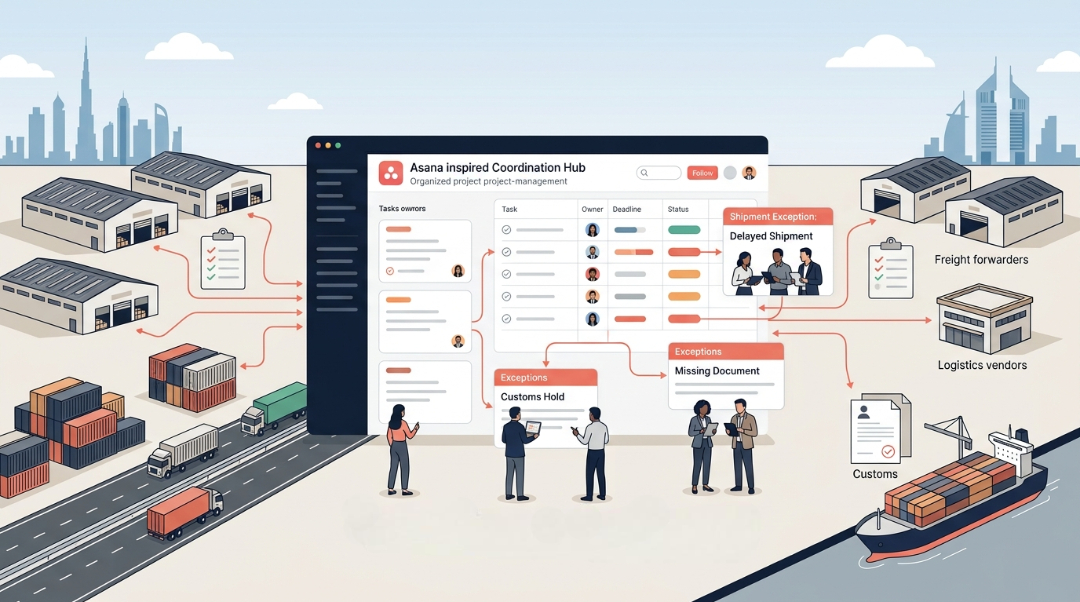
Dubai's position as a global logistics hub means UAE-based supply chain teams are often coordinating across more moving parts than most other industries — multiple warehouses, freight forwarders, customs processes, and vendors who may not even be on the same software. When one shipment slips, it rarely stays contained to that one shipment; it cascades into downstream delays that nobody sees coming until a customer asks where their order is. Asana isn't a warehouse management system or a freight tracking platform, but it's very good at the coordination layer connecting all of those systems to the people managing them.
Warehouse management systems and freight tracking platforms handle inventory levels and shipment status well. What they're rarely built for is coordinating the people around exceptions — a delayed shipment that needs a decision, a customs hold that needs follow-up, a vendor who hasn't confirmed a delivery window. Asana fills that gap without duplicating what your WMS or freight tools already do, giving your team a place to track who owns each exception and what happens next.
The key structural decision here is not trying to replicate full shipment tracking inside Asana — your freight or WMS platform already does that better. Instead, structure Asana around exceptions: shipments that need a human decision or follow-up, not every shipment moving normally through the pipeline.
A shipment only becomes an Asana task when it needs attention — delayed, held at customs, disputed — keeping the workspace focused on what actually needs human intervention.
Every exception task has one assigned owner responsible for resolution, removing the "everyone's aware, nobody's accountable" pattern.
Fields for shipment ID, carrier, destination, and delay reason keep exception tasks searchable and reportable without duplicating full tracking data.
For operations running more than one warehouse or distribution point, the same site-based structure that works for construction and retail applies here: one project per warehouse for local operational tasks, rolled up into a shared portfolio for cross-warehouse visibility. Inventory discrepancies, staffing issues, or equipment problems specific to one location stay contained to that warehouse's project, while leadership gets a single view of active issues across every site without visiting each one.
External parties — freight forwarders, customs brokers, trucking vendors — rarely need or want full access to your internal workspace, but they do need a clean way to report status and receive requests. A structured intake form, covered in more depth in our Asana Forms guide, lets vendors submit shipment updates or flag issues without needing an Asana license, with each submission landing as a properly categorized task rather than another message in a scattered thread.
Where closer collaboration is needed, scoped guest access — limited to the relevant project only — keeps external visibility contained, the same principle we cover in our security and data handling guide.
Customs holds and documentation issues are exactly the kind of exception that benefits from structured tracking — they carry real financial consequences (demurrage, storage fees) if they sit unresolved, and they usually require chasing a specific document or approval from a specific party. A dedicated task with a clear due date, an owner, and a checklist of what's outstanding turns a customs delay from a vague, anxiety-inducing problem into a trackable, resolvable one.
Supply chain leadership typically wants to know one thing above all else: how many active exceptions exist right now, and how serious are they. A portfolio rolling up every warehouse's and shipment category's exception tasks answers that directly — echoing the same reporting principle covered in our Goals and Portfolios guide, applied specifically to exception management rather than project milestones.
Logistics and supply chain coordination has a specific pattern — exception-based, multi-party, and time-sensitive — that a generic project template doesn't account for. This is what we build into every logistics implementation.
We build Asana to coordinate around what needs human attention, without duplicating your existing WMS or freight tracking systems.
Intake forms and scoped guest access are set up for external parties from the start, not added later.
Exception portfolios give leadership a live view of active issues across every warehouse and vendor relationship.
Supply chain teams don't need Asana to track every shipment — they need it to catch the exceptions before they cascade into customer-facing problems. Structured around exceptions, warehouses, and vendor coordination, Asana becomes the layer that connects your existing systems to the people actually resolving issues, without duplicating what those systems already do well.
If exceptions are still getting discovered from a customer complaint, book a free consultation with SassyOS and we'll show you what a properly structured setup looks like.
Core Asana Services
Feature Guides
Industry Use Cases
Reporting & Automation
We'll build your Asana workspace around exceptions, warehouses, and vendor coordination — so problems surface before they become customer issues.
Book a Free Consultation Get in Touch