


 By
- Aaliya Yousaf.
 Blog
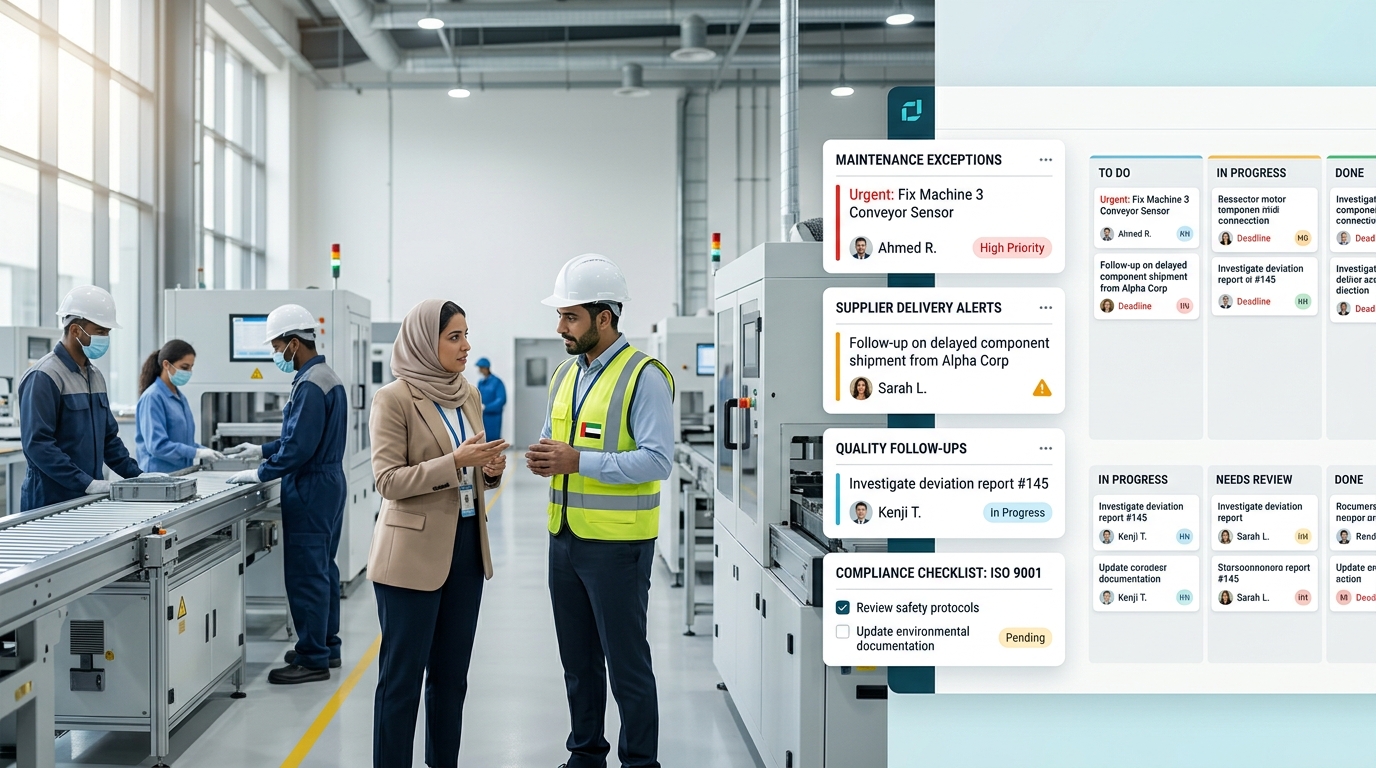
A production floor runs on its own systems — MES platforms, ERP software, quality management tools built specifically for tracking output, defects, and inventory. What those systems don't usually handle well is the coordination work happening around production: a maintenance request for a machine that's underperforming, a supplier delivery that's running late and threatens a production run, a quality issue that needs follow-up beyond just logging the defect. That coordination layer, common across manufacturing operations in the UAE's industrial zones, is where Asana adds value without duplicating specialized production systems.
Real-time production data, machine telemetry, and inventory levels belong in your MES and ERP systems, which are built specifically for that data and typically already do it well. Asana's role is the operational coordination happening around production — cross-functional tasks, exceptions, and follow-up work — not a replacement for specialized manufacturing software.
Preventive maintenance schedules typically live in dedicated maintenance management software, which is the right place for that data. What often lacks a proper home is the follow-up when something goes beyond routine servicing — a machine underperforming, a repeated fault, a repair that needs parts ordered and a technician scheduled. A structured intake form, covered in more depth in our Asana Forms guide, lets floor staff flag equipment issues quickly, with the resulting task assigned to maintenance with clear ownership through to resolution.
A delayed raw material delivery threatens a scheduled production run, and the earlier that risk surfaces, the more options exist to adjust. Following the same exception-based pattern covered in our logistics and supply chain guide, a supplier delay becomes a task the moment it's flagged — with an owner responsible for chasing resolution or adjusting the production schedule — rather than a risk that's only discovered once the material fails to arrive on the expected date.
Your quality management system logs defects and non-conformances well. What it doesn't always track cleanly is the corrective action that follows — who's investigating the root cause, what process change is being implemented, and whether it's actually been verified as resolved. A task referencing the quality system's non-conformance number, tracking the corrective action through to close-out, keeps that follow-up visible and accountable rather than ending at the point the defect was simply logged.
Bringing a new product or product variant into production involves a fairly consistent sequence — specification sign-off, trial run, quality validation, documentation, full production release — that benefits from being a repeatable template rather than reconstructed from memory each time. Dependencies between these stages matter here too, the same principle covered in our Timeline and Gantt chart guide, since skipping a validation step to save time on the schedule usually costs more downstream than it saves.
Manufacturers operating more than one facility benefit from the same portfolio structure used across other multi-location businesses: one project per facility for local operational and exception tasks, rolled up into a shared portfolio giving operations leadership a single view of open issues, maintenance backlogs, and quality follow-ups across every site.
Manufacturing facilities carry a recurring compliance load — safety audits, equipment certifications, environmental compliance checks — with real consequences for lapses. Recurring tasks tied to each renewal or check interval, with generous advance reminders and a photo or checklist attached on completion, turn a compliance calendar that might otherwise live in a binder into a tracked system with a usable audit trail.
Manufacturing coordination has a specific pattern — exception-driven, cross-functional, and tightly linked to specialized systems already in place — that a generic project template doesn't account for. This is what we build into every manufacturing-focused implementation.
We build Asana to coordinate around what needs human follow-up, without duplicating your MES, ERP, or quality management systems.
We build repeatable, dependency-mapped checklists so validation steps never get skipped under schedule pressure.
Portfolio rollups give operations leadership a live view of open issues across every facility.
Manufacturing teams don't need Asana to run production — they need it to catch the exceptions and cross-functional follow-up that specialized production systems don't handle well. Structured around maintenance exceptions, supplier risk, and quality follow-up, Asana becomes the coordination layer connecting your existing systems to the people resolving issues, without duplicating what those systems already do.
If exceptions on your production floor are still tracked in a notebook, book a free consultation with SassyOS and we'll show you what a properly structured setup looks like.
Core Asana Services
Feature Guides
Related Industries
Reporting
We'll build your Asana workspace around maintenance exceptions, supplier risk, and quality follow-up — alongside your existing MES and ERP systems.
Book a Free Consultation Get in Touch