


 By
- Aaliya Yousaf.
 Blog
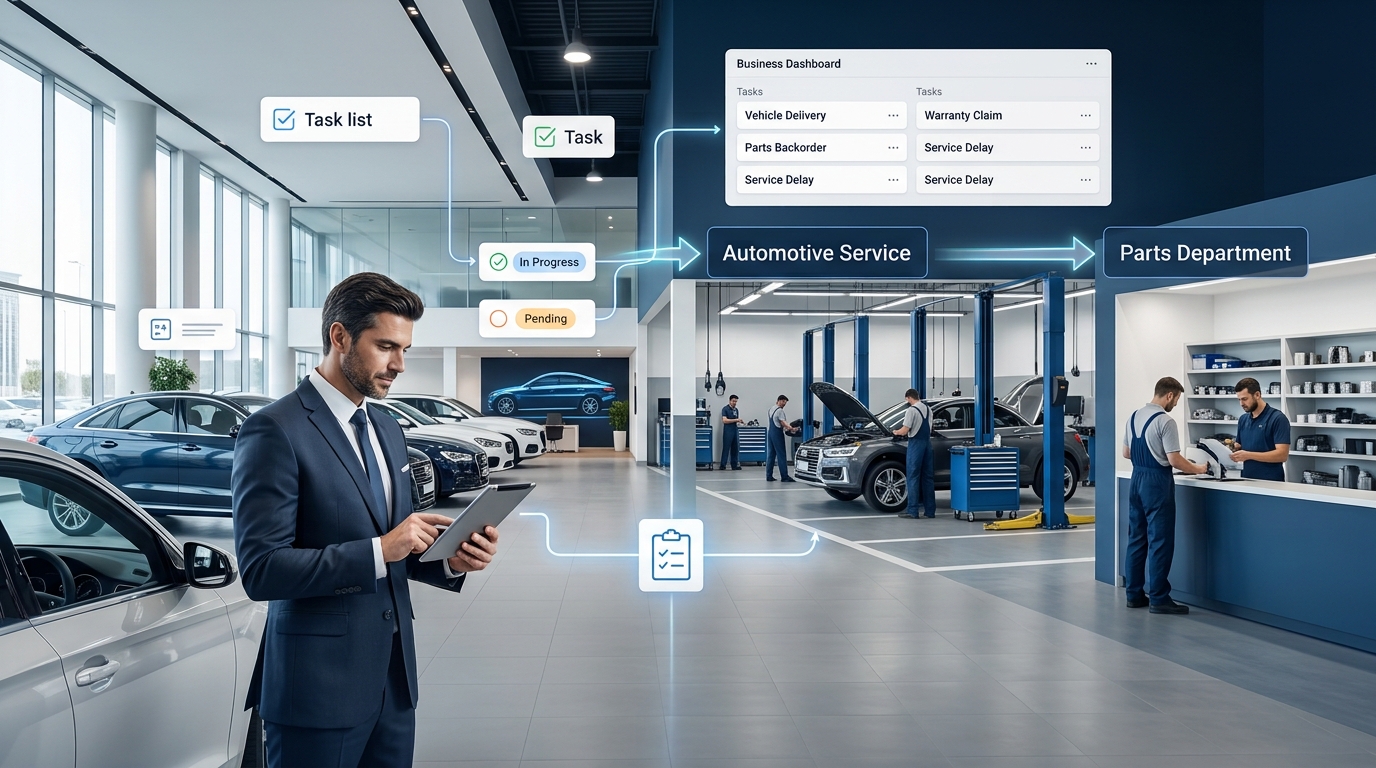
A dealership runs three businesses under one roof — vehicle sales, service and repair, and parts — each with its own pace and its own software, but constantly needing to hand off to each other. A sales delivery waiting on a pre-delivery inspection. A warranty claim that needs manufacturer approval before work starts. A parts order that's the only thing standing between a customer and a finished repair. Your DMS handles the transactional side of each department well. What it doesn't always handle is the cross-department coordination that determines whether a customer's experience feels seamless or scattered.
Vehicle inventory, service records, and transaction data belong in your dealer management system, which already handles that well. What's usually missing is the coordination around exceptions and cross-department handoffs — a delayed part, a warranty claim awaiting approval, a pre-delivery inspection that needs sign-off before a sale closes. Asana fills that specific gap without duplicating what your DMS already tracks.
Between a sale closing and a vehicle reaching the customer, several steps need to happen in the right order — pre-delivery inspection, accessory fitting, documentation, final cleaning. A shared checklist project tied to each pending delivery, with tasks assigned across sales and service, gives both departments a clear view of what's outstanding and removes the "is this ready yet" back-and-forth that otherwise happens over phone calls between departments.
A warranty claim awaiting manufacturer approval sits in a state of limbo that's easy to lose track of, especially with multiple claims in progress at once. A task tracking the claim through submission, approval, and completion — referencing the claim number rather than duplicating manufacturer system data — keeps that follow-up visible, with a clear owner responsible for chasing approval rather than the claim quietly aging in an inbox.
A repair frequently stalls entirely on a single part, and a backordered part with no active follow-up quietly extends a customer's wait far longer than necessary. Following the same exception-based pattern covered in our logistics and supply chain guide, a backorder becomes a task the moment it's flagged, with an owner responsible for chasing the supplier or communicating a revised timeline to the customer rather than letting it sit unmonitored.
Most vehicles moving through service follow a predictable process your DMS already tracks well. What benefits from Asana specifically is the exception — a repair taking longer than quoted, an additional issue discovered mid-service that needs customer approval before proceeding, a technician flagging something outside their expertise. A structured intake form lets service staff flag these exceptions quickly, routing to the right supervisor with the urgency clearly indicated.
Dealership groups operating multiple showrooms or service centers benefit from the same portfolio structure used across other multi-location businesses: one project per branch for local exceptions and coordination tasks, rolled up into a shared portfolio giving group management a single view of open warranty claims, backorders, and delivery delays across every location.
As with any customer-facing operation, it's worth being deliberate here: customer personal details, payment information, and full vehicle history belong in your DMS or CRM, not written directly into Asana tasks. Asana should reference a job or claim number for operational coordination, rather than storing the customer's personal or financial data itself.
Dealership operations involve a specific mix of cross-department handoffs and time-sensitive exceptions that a generic project template doesn't account for. This is what we build into every automotive-focused implementation.
We build shared delivery checklists so both departments stay aligned on what's outstanding before a sale closes.
We structure clear ownership for claims and backorders, so nothing ages silently in an inbox.
We build group-level visibility across every showroom and service center.
Sales, service, and parts each run well on their own systems — the friction shows up in the handoffs between them. Structured around delivery checklists, warranty follow-up, and parts exceptions, Asana closes those cross-department gaps without duplicating what your DMS already tracks well.
If handoffs between your departments still rely on phone calls and memory, book a free consultation with SassyOS and we'll show you what a properly structured setup looks like.
Core Asana Services
Feature Guides
Related Industries
Reporting
We'll build your Asana workspace around delivery checklists, warranty follow-up, and parts exceptions — alongside your existing DMS.
Book a Free Consultation Get in Touch